The World Recycles More Than Ever. Global Circularity Is Still Falling.
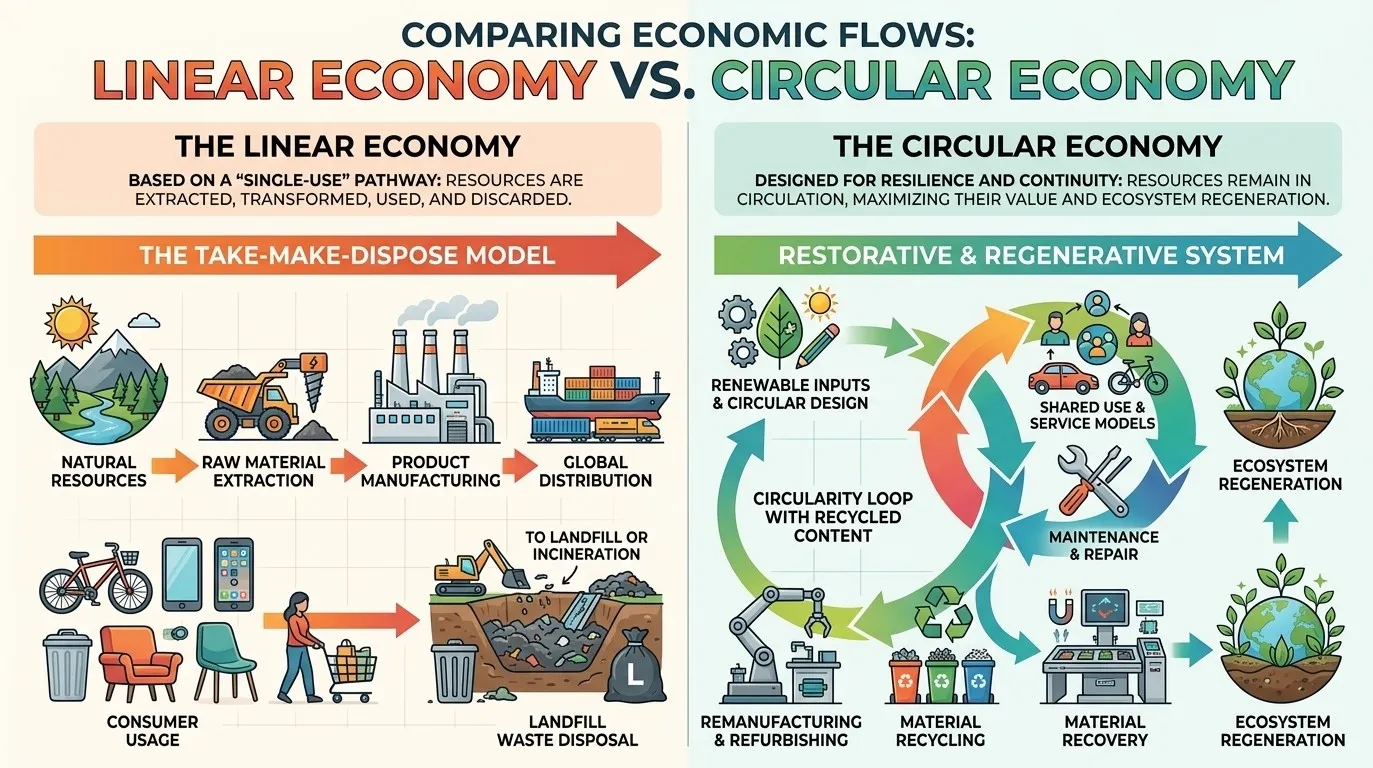
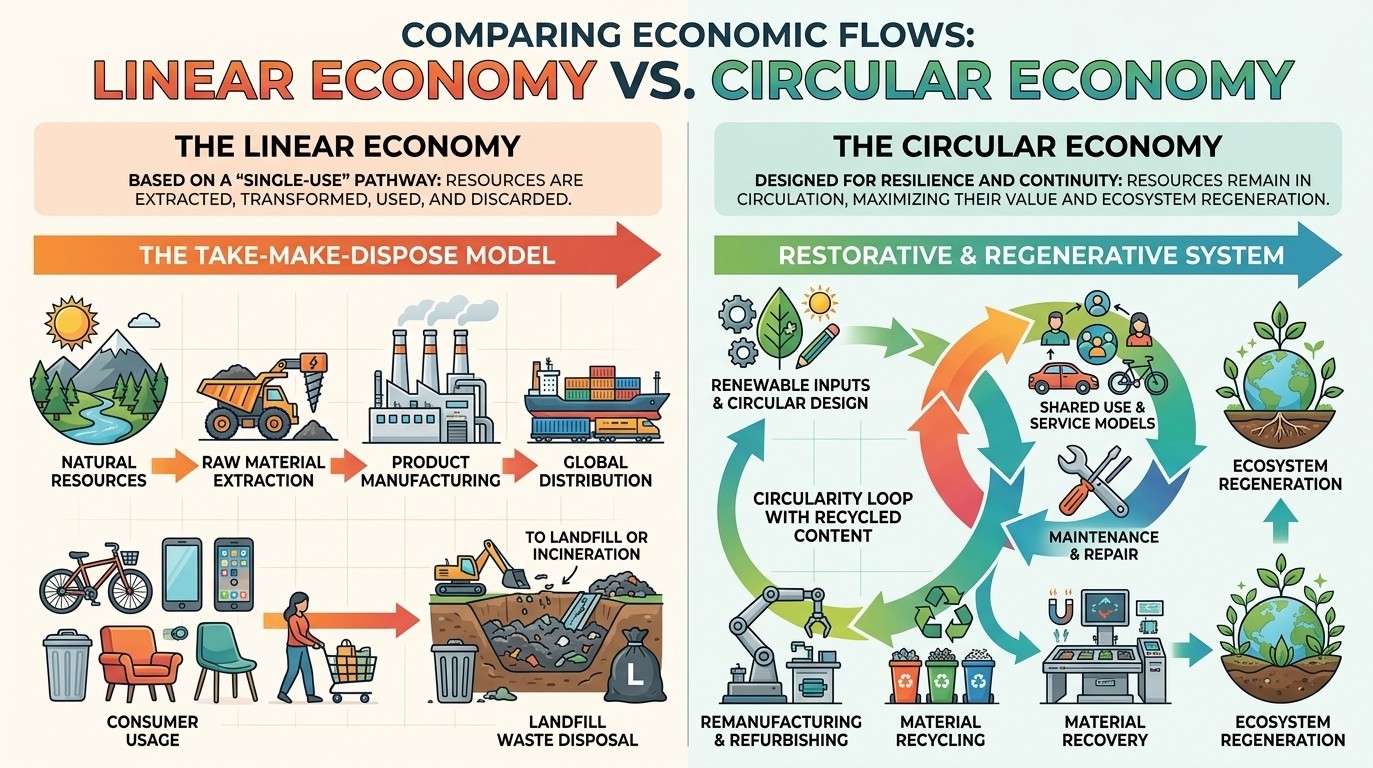
In 2018, Circle Economy published the first Circularity Gap Report and reduced the global economy to a single number: 9.1% circular. Just over nine percent of the materials flowing into the world economy came from recycled sources. The rest was dug, pumped, felled or harvested new.
Seven years on, that number has not improved. It has fallen to 6.9% — meaning 93.1% of everything entering the global economy is virgin material.
The obvious reading is that recycling is failing. That reading is wrong, and the real explanation is more uncomfortable.
The problem is the denominator
Circularity, as measured here, is a ratio: recycled material in, over total material in. A ratio can fall while its numerator rises, provided the denominator rises faster. That is precisely what happened.
Recycled material use grew by roughly 200 million tonnes between 2018 and 2021. That is genuine progress, representing real infrastructure, real collection systems and real policy. And the ratio still went backwards, because total material consumption grew faster.
The scale of that growth is the whole story. Global material use has gone from about 30 billion tonnes in 1970 to around 106 billion tonnes today, according to the UN International Resource Panel’s Global Resources Outlook 2024. The same report projects extraction will rise a further 60% by 2060.
No plausible expansion of recycling closes a gap growing at that rate. A recycling system would have to absorb all of current demand and all of the growth merely to hold the percentage still.
Three reasons recovery cannot catch up
Even a perfectly efficient recycling system would not reach 100%. Three structural effects stand in the way, and none of them is a matter of effort.
Materials vanish into stock
A large share of what gets extracted does not come back as waste for decades, because it is still in use. Concrete, steel and copper go into buildings, roads, pipes and grids with service lives measured in generations.
In a growing economy this is a permanent arithmetic disadvantage. The material available to recycle today reflects what was consumed thirty or fifty years ago, when the economy was far smaller. New stock is accumulating faster than old stock retires, so the recycling pool is always drawing on a smaller past.
Materials dissipate
Some materials cannot be recovered at any price, because they do not stay in one place. Fossil fuels are burned and become emissions. Tyres shed particles onto roads. Zinc coatings erode. Fertilisers wash into watersheds. Brake pads turn into roadside dust.
These are not collection failures. The material is gone in any practical sense, thermodynamically scattered beyond recovery.
Materials degrade
Most of what is described as recycling is more accurately downcycling. Paper fibres shorten each time they are pulped. Mixed plastics return as lower-grade polymers with narrower uses. Recycled steel accumulates copper contamination from mixed scrap, limiting what it can become.
Each cycle buys time rather than closing the loop. The material steps down a grade and approaches the point where there is nowhere left to step.
Why the number matters beyond the metric
It would be easy to treat this as a statistic for specialists. It is not, because material flows and climate are substantially the same problem.
The IRP attributes more than 60% of planet-warming emissions to resource extraction and processing. For biomass specifically — agriculture and forestry — extraction and processing account for 90% of land-related biodiversity loss and water stress.
Note what that implies. Climate policy concentrated on the energy mix, while treating materials as a separate matter for waste departments, is addressing a minority of its own problem.
The burden is not evenly shared
The IRP also found that high-income countries consume around six times more materials per capita than low-income countries, and are associated with roughly ten times the climate impacts.
This is the part most often missing from coverage written in London, Brussels or New York. The consumption driving extraction is concentrated in wealthy economies; the mining, processing and disposal frequently are not. A national recycling rate can improve while the extraction it depends on, and the waste it exports, simply relocate.
What would actually move the number
If recovery cannot outrun growth, the remaining levers act on the denominator: using less material per unit of output, and building things that last.
The discouraging finding here is that global resource productivity — economic output per tonne of material — has effectively stalled over the past decade. The world is not getting better at converting materials into value. It is simply using more of them.
What recycling is still for
None of this is an argument against recycling. Recycled aluminium requires a fraction of the energy of primary production. Steel recycling is mature and genuinely circular in large parts of its use. Recovering critical minerals reduces dependence on a small number of mines in a small number of countries.
But recycling is a mitigation, not a solution. It slows the rate at which materials leave the economy. It does not determine how many enter it.
The number to watch
The circularity rate is a useful diagnostic and a poor target. It can be improved by recycling more, or by consuming less — and only one of those addresses the underlying problem.
The figure that actually describes the trajectory is total extraction: 106 billion tonnes a year, heading for 60% higher by 2060. Until that line bends, the circularity percentage will keep falling no matter how much better the recycling gets.
Sources: Circle Economy, Circularity Gap Report; UN International Resource Panel, Global Resources Outlook 2024.