India's E-Waste Rules Are Tightening. The Trade Is Moving, Not Shrinking.
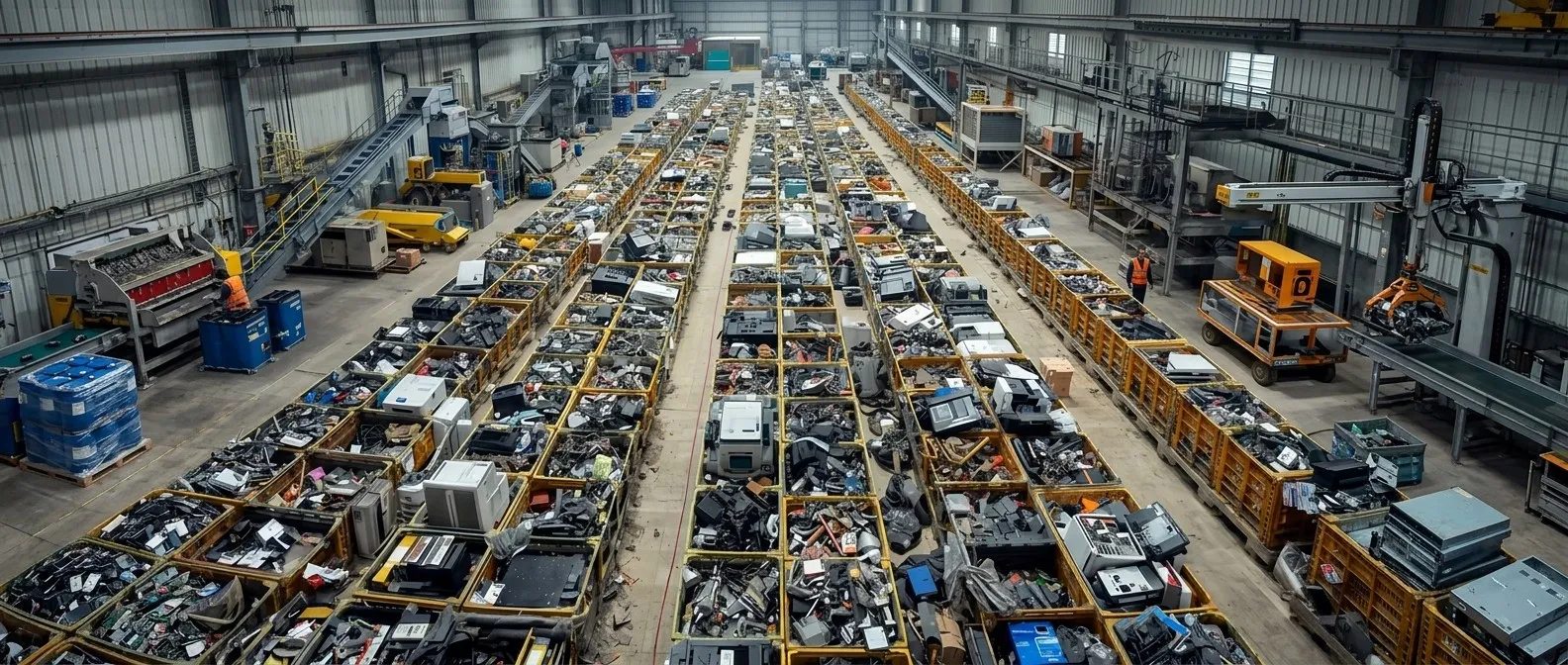
Coverage of India’s e-waste sector tends to arrive in one of two registers. Either the rules are tightening and recycling is modernising, or there are photographs of children near burning cable.
Both are true. Neither explains the thing that actually matters: why, after a decade of regulation, most of India’s electronic waste still moves through an informal network — and what happens to the people in it when policy finally starts to bite.
The numbers, and why they disagree
India’s Central Pollution Control Board put e-waste generation at 13.97 lakh tonnes (about 1.4 million) in FY2024–25, up from 12.54 lakh the previous year, and roughly double the 7.08 lakh tonnes recorded in 2017–18. NITI Aayog projects around 14 million tonnes by 2030.
Then the series stop agreeing. A Rajya Sabha answer gave 1.751 million tonnes for 2023–24, well above the CPCB figure for the same year. The widely recycled “3.23 million tonnes” is a 2019 global-monitor estimate measuring something else again.
Estimates of the informal share diverge further still:
- NITI Aayog, as reported: about 62%, employing half a million people
- Government estimates cited in current litigation: at least 80%
- Academic work: over 90% (a 2020 estimate)
- An older 2007 study: 97%
That spread — 62% to 97% — is itself the finding. The gap between “generated” and “recycled” in official statistics is frequently read as the size of the informal sector, which it is not; it is the size of what the formal system did not record. A policy aimed at shrinking a quantity nobody can measure within a factor of nearly two is operating substantially blind.
Why the informal sector wins
The persistent framing error is treating informal collection as an enforcement failure. It is better understood as a competing service that is winning on merit.
Convenience. A collector comes to the door. A certified recycler typically expects you to bring the item to a facility. India has roughly 2,808 authorised collection centres for a population over 1.4 billion.
Immediate cash. Households are paid on the spot. Formal channels offer paperwork and, often, nothing.
Shared economics. A GPS-tracked study found collectors covering 20–30 km a day by three-wheeler, with e-waste making up only about a tenth of what they pick up. That is the decisive structural advantage: e-waste collection rides on an existing scrap round that is already economically viable. A formal recycler building a dedicated collection network is competing against marginal cost.
No paper trail. Procurement is in cash with no GST record, which suits both sides of the transaction.
The consequence is that formal plants run under capacity, which raises their per-unit costs, which makes them less able to outbid collectors. The loop is self-reinforcing. And it is not one-directional: a 2019 Toxics Link study reported authorised dismantlers selling material back into the informal sector, in violation of the rules.
Formal recyclers in India are not losing on technology. They are losing on logistics.
The cost, stated plainly
None of that makes the informal system acceptable. The recovery is real; the price is paid by the people doing the work.
Seelampur in north-east Delhi is the best-documented cluster — one 2019 study attributed around 57% of informal processing units to it. Workers handle lead, mercury, cadmium and tin during dismantling, with reported outcomes including respiratory and skin disease. Roughly one in ten workers uses protective equipment regularly; cost and discomfort are the reasons given. A local doctor describes daily patient numbers rising from five to twelve, to twenty or thirty — largely skin infections and chronic obstructive pulmonary disease, including in small children, which he attributes partly to the burning of wire and plastics. Reported earnings range from roughly ₹200 to ₹1,000 a day.
One evidence caveat worth stating: several broader health reviews do not clearly separate e-waste workers from bystanders in the same neighbourhoods, so worker-specific risk estimates remain thinner than the scale of the problem warrants.
What the 2022 Rules changed
The E-Waste (Management) Rules, 2022 took effect on 1 April 2023 and restructured the regime rather than merely tightening it:
- Covered equipment categories went from 21 to 106
- Obligations shifted from collection targets to recycling targets
- Targets step up: 60% for FY2023–24 and 2024–25, 70% for the following two years, 80% from FY2027–28
- Producers, recyclers and refurbishers register on a CPCB portal, and may not trade with unregistered entities
- Producers meet obligations by buying tradable EPR certificates from registered recyclers, issued against four recovered outputs: gold, copper, aluminium and iron
- Solar modules were brought into scope, with no recycling target until 2034–35
Note what the certificates measure. They are issued on recovered metal. Not on whether the material was handled safely, not on who collected it, and not on whether anyone in the chain is better off. It is an output count — exactly the kind of number that records a transaction rather than an outcome.
And the rules contain no mechanism for the binding constraint. A 2025 Rajya Sabha reply confirmed there is no provision for funding the construction or upkeep of processing facilities — and nothing at all for building collection, which is where the formal sector actually loses.
The price floor fight
The 2024 amendments did the one thing that directly changes formal recyclers’ economics: they banded EPR certificate prices between 30% and 100% of the environmental compensation rate, setting a floor of ₹22 per kilogram for consumer electronics.
Producers went to court. Havells filed first in November 2024, joined by Daikin, Voltas, Blue Star and Carrier’s Indian unit. Johnson Controls-Hitachi later withdrew. Reporting on Samsung and LG conflicts — Reuters reported in April 2025 that both had filed suit, while other coverage describes them as having signalled concern without litigating. The court record is the authority; treat the widely-repeated version with caution.
The arguments are substantive on both sides:
- Producers argue the Environment Protection Act gives no power to regulate commercial terms between private parties, and that the floor is arbitrary. They say it roughly triples compliance costs; Samsung reportedly told officials its costs would rise five to fifteen times.
- Government argues a floor prevents a race to the bottom that would leave formal recycling financially unviable.
- Formal recyclers point out the floor is the only thing letting them compete at all, since informal operators are not bound by it.
One detail cuts through the legal argument. Newslaundry reported that a Hitachi-linked venture accepted bids at ₹5–6 per kilogram, far beneath the mandated floor. Whatever the court decides about the regulator’s powers, the market price for this work is a fraction of what the rules declare it to be.
In December 2025 the CPCB added a self-attested declaration to its certificate trading portal; Blue Star obtained an interim stay. As of the most recent reporting I could find, no final judgment has issued and the band remains operative.
What is happening on the ground
Here is the part that should trouble anyone who supports the direction of the rules, and the direction does seem right.
Reporting from Delhi’s e-waste hub describes work draining out of Seelampur as processing shifts to licensed operators. One wire-peeler described it as being pushed back into becoming a worker, lacking both the capital and the technical knowledge to open a licensed plant. Formal operators acknowledge they still need informal labour, but say their capacity to absorb displaced workers is limited.
A Toxics Link officer makes the critical observation: volumes have not really fallen. The activity has become harder to see in Delhi, dispersing into outlying towns and household settings.
That is the opposite of what the policy intends, and worse than the status quo in one specific respect. A concentrated cluster is visible, researchable, and reachable by inspectors and health services. The same tonnage spread across unmarked domestic premises in smaller towns is none of those things. The hazard has not been removed. Its monitoring has.
A 2019 Toxics Link survey reportedly found 92% of informal processors unaware of the E-waste Rules at all. Policy cannot formalise what it has never contacted; it can only push it further from view.
Why this is the real test of EPR
Extended producer responsibility assumes the formal sector is the destination and informal activity is leakage to be closed off. In India that assumption runs backwards. The informal network is the collection infrastructure. It is the only system reaching households at a cost anyone has managed to sustain.
Raising the price formal recyclers receive, without building the collection capacity they lack, raises the value of material the formal sector still cannot obtain. That is how a certificate market grows while the physical problem relocates.
It is the same pattern we keep finding, in a setting where the consequences are measured in lung function rather than accounting: chemical recycling’s unmeasured yields, self-declared repairability scores, and now certificates issued on recovered metal. In each case the official number is real, auditable, and beside the point.
What integration would require
The constructive version is well mapped, if under-funded. Researchers and practitioners have proposed organising collectors into cooperatives, state-backed identity and registration, funded safety and skills training, minimum-wage mechanisms, and licensed pathways letting existing collectors sell into formal channels without capital they do not have. Pilots exist — the recycler Attero has tested direct tie-ups with Seelampur dealers — but they are small.
The warning from researchers at GRID-Arendal is worth repeating: formalisation without rights protection can leave informal workers materially worse off than before.
The strategic point is simpler than it is usually made. The door-to-door collection network is the most valuable asset in India’s e-waste system. It took decades to build, nobody funded it, and no formal operator has replicated it. A policy that dismantles it in order to formalise it will have destroyed precisely the thing that worked.
The question is not whether this material should be handled safely. It obviously should. The question is whether pricing formal recycling, without funding formal collection, achieves anything beyond moving the hazard somewhere nobody is photographing.
Sources: Press Information Bureau, E-Waste (Management) Rules, 2022; NITI Aayog via ThePrint; Context / Thomson Reuters Foundation; Newslaundry; Al Jazeera.