A Circuit Board Holds Sixty Elements. Europe's Best Smelter Recovers Seventeen.
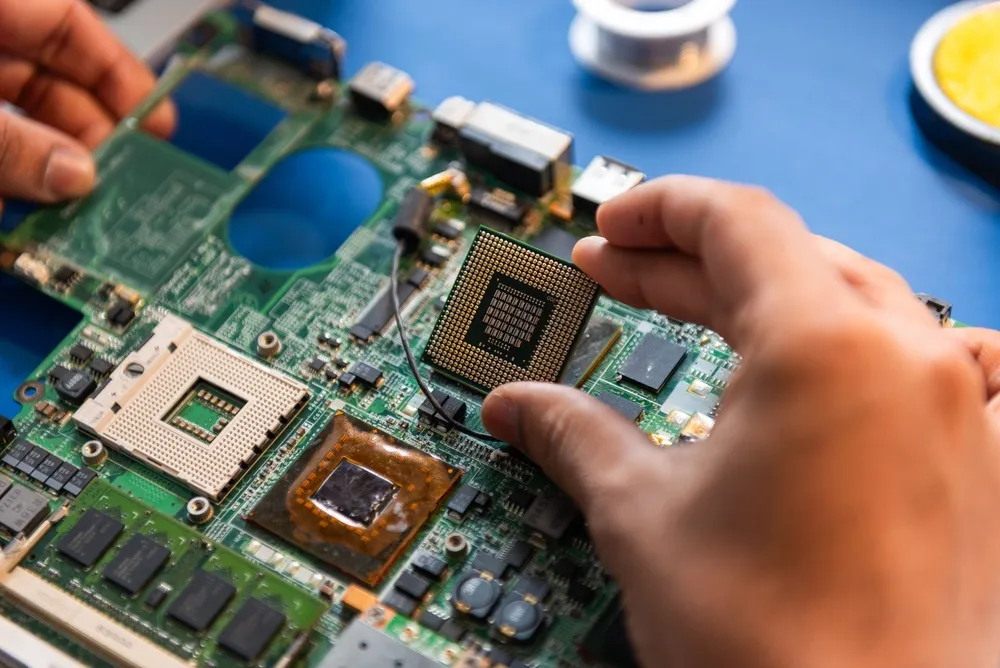
A computer motherboard is one of the most concentrated deposits of valuable metal any ordinary person will ever hold. It is also, by the measure Europe actually uses, almost fully recycled already.
Both of those statements are true, and the distance between them is this article.
The richest ore you will ever hold
Gold ore is mined at roughly 5 grams per tonne. Marginal deposits are worked at less. Entire industries, with open pits visible from orbit, exist to process rock at that grade.
Computer circuit boards run at 200 to 250 grams per tonne. A 2019 peer-reviewed assay of mobile phone boards measured 475 grams per tonne in its representative sample.
So a tonne of scrap boards is somewhere between forty and a hundred times richer in gold than the rock a mining company would move a mountain to reach. That spread is worth pausing on: the ratio depends entirely on which ore grade you pick as the baseline, and sources choose different ones. We have seen both “forty times” and “a hundred times” quoted with equal confidence. Both are defensible. Neither is a fact about circuit boards.
What is not in dispute is the direction. The phrase people use for this is urban mining, and for once the marketing language understates it. The deposit is richer than the mine.
What actually comes out
Umicore’s plant at Hoboken, in Belgium, is the reference facility for this work — the place European e-scrap goes when somebody intends to do the job properly. It processes over 200 distinct input streams and is in the middle of a €100 million expansion to raise capacity by 40%.
It recovers 17 metals.
A published account of the plant from 2016 names them in four groups: the precious metals silver, gold, platinum, palladium, rhodium, iridium and ruthenium; the specialty metals indium, selenium and tellurium; antimony, tin and bismuth; and the base metals lead, copper and nickel. That list runs to sixteen. Umicore’s own count is seventeen, and we could not reconstruct the last one from published sources — a small illustration of how thin the public detail is even for the best-documented plant in the sector.
Seventeen is an impressive number. It is also, set against the roughly sixty elements that go into modern electronics, a minority of the periodic table.
The reason is metallurgical rather than commercial. The process works by collector metallurgy: molten lead, copper and nickel act as solvents that gather the precious metals out of the feed. Anything the collectors do not dissolve reports to the slag. That is a chemical fact about which elements dissolve in which melts, not a decision anybody makes board by board.
Gallium, tantalum, the rare earths, most of the specialty metals that give a board its actual capabilities — these are not recovered because they are not recoverable by this route, at any price.
The target is a weight
Here is where the policy meets the chemistry.
The WEEE Directive (2012/19/EU) sets minimum recovery targets in its Annex V, and since 15 August 2018 they run by Annex III category: 85% recovery and 80% preparing for re-use and recycling for the largest equipment categories, 80% and 70% for screens, 75% and 55% for small equipment.
Every one of those is a percentage by weight. The rate is the mass of material sent to recovery over the mass collected.
Now put that beside what a board is made of. The heavy fraction is steel, aluminium, copper and fibreglass laminate. The elements that make the board a strategic object — the ones in the Critical Raw Materials list — are present in milligrams.
Recover the steel and the copper, and you have hit 85% by weight while leaving the gallium, the tantalum and the rare earths in the slag. The target is met. Nobody cheated. The number is real.
(We should flag that the directive text we could reach is the UK’s retained copy, which carries a note that no amendments have been applied since the end of the Brexit transition period, and the category figures were partly garbled in the sources we checked. The structure of the targets is not in doubt; the exact per-category percentages are worth verifying against EUR-Lex before quoting them anywhere that matters.)
Iron is 70% of the weight and 15% of the value
That mismatch is not just an argument. Somebody measured it.
A 2023 study in the Journal of Industrial Ecology applied an exergy-based indicator called thermodynamic rarity — essentially the energy cost of getting a material from dispersed rock to usable market form — to Italian WEEE streams, across small electronics and screens.
The result:
- Iron: over 70% of the mass, under 15% of the rarity.
- Tungsten: under 0.1% of the mass, over 6% of the rarity.
Tungsten is seven hundred times less significant than iron if you weigh it, and roughly four tenths as significant if you measure what it cost the planet to put it there.
A target denominated in kilograms cannot see that difference. It is not that the WEEE target is set too low; it is that the quantity it counts is nearly uncorrelated with the quantity anyone cares about. The authors make exactly this argument — that mass-based rates are the wrong instrument, and that rarity could inform both target-setting and which materials get prioritised for recovery.
Readers of our piece on construction and demolition waste will find this familiar. There, 89% recovery was real and mostly meant crushing concrete into road sub-base. Here, 85% recovery is real and mostly means steel and copper. In both cases the policy works exactly as drafted and measures the wrong thing.
The number everyone cites is from 2011
If you read anything about metal recycling, you will meet this statistic: of around sixty metals studied, fewer than a third have an end-of-life recycling rate above 50%, and 34 of them sit below 1%.
It is a genuine, careful finding. It comes from Recycling Rates of Metals: A Status Report, produced by UNEP’s International Resource Panel.
It was published in 2011.
Fifteen years on, it remains the number in circulation, reproduced across policy documents and press coverage, usually with no date attached. We have not found a comparable successor study — not a contradicting one, not a worse-funded one. The canonical measurement of how much of the periodic table we recover is old enough to have been compiled before the modern smartphone supply chain existed.
This is the third time we have hit this exact wall. The American e-waste recycling rate is stranded in 2018. The Kantamanto textile volume figure is years stale and contested by the parties who produced it. Now the foundational metals statistic turns out to predate the decade it is being used to describe.
One related figure is worth putting beside it, because it isolates the problem: gold in industrial applications is recycled at 70–90%. Gold in electronic goods is recycled at 10–15%. Identical metal, identical value per gram. The difference is entirely how it is embedded.
Europe noticed, and then declined to require anything
The Critical Raw Materials Act (Regulation (EU) 2024/1252) entered into force on 23 May 2024. It lists 34 critical raw materials, of which 17 are designated strategic. For 2030 it sets benchmarks: 10% of annual consumption from EU extraction, 40% from EU processing, no more than 65% from any single non-EU country, and 25% from recycling.
Twenty-five percent of strategic raw material consumption, met by recovery. That is a serious ambition, and it is aimed squarely at the gap described above.
The Council describes these benchmarks as non-binding. Secondary sources disagree — at least one glossary calls them binding — and we would treat the Council’s own characterisation as the reliable one, while noting that the cleanest answer is in the regulation’s text rather than in commentary about it.
So the position is: a mandatory recycling target measured in a unit that cannot detect critical materials, and a critical-materials recovery benchmark that is not mandatory. The binding instrument counts the wrong thing; the instrument counting the right thing does not bind.
(The 17 strategic raw materials and Umicore’s 17 recovered metals are different sets. The coincidence of the number means nothing, and we mention it only to head off the inference.)
Why this is harder than a target can fix
It would be convenient if this were negligence. It mostly is not.
Dispersal is the enemy. A tonne of boards is rich in gold because gold is concentrated in thin plating and bond wires. The same boards are poor in neodymium because neodymium is spread through components in milligram quantities, alloyed and bonded. Concentration, not abundance, is what makes recovery possible.
Thermodynamics sets a floor. Once an element is dilute and chemically bound into a mixed stream, separating it costs energy that rises steeply as concentration falls. For some elements the recovery energy exceeds the primary production energy, at which point recycling is worse than mining by the only measure that matters.
The collectors decide. Because the smelting route works by dissolution into lead, copper and nickel, the recoverable set is fixed by chemistry upstream of any policy choice. You do not get tantalum out of that process by wanting it more.
Design is where the leverage is. Which is to say the decision that determines recoverability was made years earlier, by whoever specified the board. That is the argument for digital product passports and, eventually, for design rules — neither of which is a recycling target.
What this means for a board in a drawer
The practical consequence runs the opposite way to intuition.
If recovery loses most of the periodic table, then the value of a working board is overwhelmingly in it continuing to work. Recycling a functioning motherboard converts a precisely engineered object into copper, a little gold, and slag. It is the least valuable thing you can do with it that still counts as responsible.
So the order holds, and it is the same order as for a phone or a laptop: keep a working machine working, sell or pass on what you no longer want, repair what is repairable, and recycle only what is genuinely dead. Buyback services sit in the second category — Gadget Salvation and others like it quote on used machines, including damaged ones, which is the route by which a board stays a board rather than becoming feedstock.
For anything truly beyond use, a certified recycler feeding a serious smelter genuinely does recover seventeen metals, and that is far better than the alternative. It is simply not the same as closing a loop.
What would settle it
Three things, in ascending order of difficulty.
Report functional recycling rates per element, not aggregate mass recovery. The data largely exists inside the plants; what is missing is an obligation to publish it on a shared definition.
Weight the target by criticality or rarity. The 2023 study is a proposal for exactly this, and the mechanism is not exotic — the Critical Raw Materials list already identifies which elements would carry the weighting.
Re-run the 2011 study. Whatever its conclusions, a current global picture of end-of-life recycling rates by element is the single most useful missing document in this field.
The uncomfortable part
The honest summary is that electronics recycling in Europe is operating close to the limit of what the chosen technology can do, hitting its targets, and losing most of what matters anyway.
There is no villain here. Umicore’s seventeen metals represent real metallurgical achievement. The WEEE targets have driven enormous, genuine diversion from landfill. The Critical Raw Materials Act identifies the right problem.
But a board holding sixty elements, processed by the best facility on the continent, surrenders seventeen — and the compliance number that describes this says 85%, because it is weighing the steel.
Sources: gold grades for circuit boards and ore from published assays and secondary coverage, where the board-to-ore ratio varies by the ore baseline chosen and is discussed above rather than resolved; Umicore’s published material and a 2016 account of the Hoboken plant for the 17-metal count and the named list, which we could reconstruct only to sixteen; Directive 2012/19/EU Annex V for the mass-based recovery targets, read in the UK’s retained copy with the caveats noted in the text; Campbell-Johnston et al., “Thermodynamic rarity of electrical and electronic waste”, Journal of Industrial Ecology 27(2), 2023, for the iron and tungsten figures; UNEP’s International Resource Panel, Recycling Rates of Metals: A Status Report (2011), for the 34-elements-below-1% finding and the industrial-versus- electronic gold rates; and Regulation (EU) 2024/1252 with the Council’s summary for the Critical Raw Materials Act benchmarks, where sources conflict on whether those benchmarks bind.