Fashion's Recycled Polyester Is 97% Bottles. Europe Has Promised Those Bottles to Someone Else.
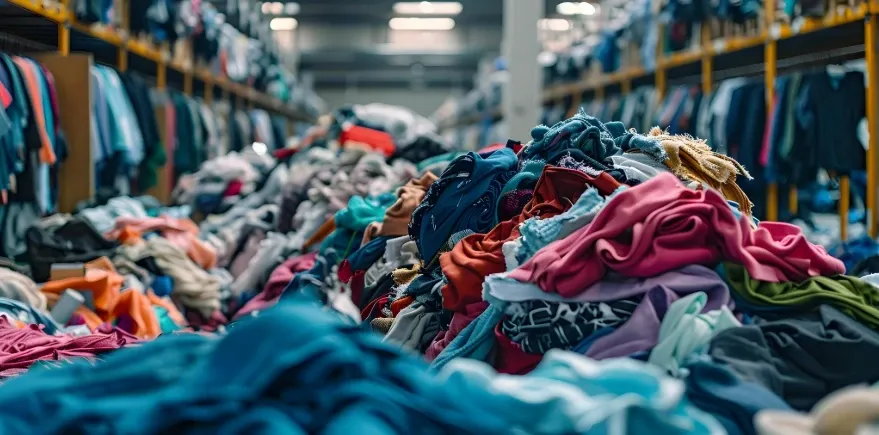
A recycled polyester garment is sold as evidence that the loop is closing. The fibre existed before, it was recovered, and it is now a jacket instead of landfill. Every part of that is true.
What the label does not say is where the fibre came from. In 2025, by Textile Exchange’s own accounting, roughly 97% of recycled polyester was made from plastic bottles and other non-textile feedstock. Almost none of it was ever clothing.
That is not a loop in the garment industry. It is a withdrawal from someone else’s. And from 2030, the industry it is being withdrawn from has a legal obligation to keep the material.
The number
Textile Exchange’s 2026 Materials Market Report, covering 2025, puts global fibre production at a record 139 million tonnes, up from 132 million the year before. Within that:
- Recycled polyester: 9.7 million tonnes, or 11.8% of all polyester
- Of that recycled polyester, about 97% came from bottles and other non-textile sources
- Textile-to-textile recycled polyester: roughly 3% of recycled polyester, which is about 0.3% of total polyester output
- Bottle-derived recycled polyester alone: 6.8% of the entire global fibre market
The bottle share is falling, but slowly: 99% in 2022, 98% in 2024, 97% in 2025. At roughly a percentage point a year, the feedstock mix is not changing on the timescale of anybody’s 2030 commitment.
The tonnage rose. The share fell.
The detail worth pausing on is that recycled polyester grew in absolute terms and shrank in relative terms at the same time. From 9.4 million tonnes in 2024 to 9.7 million in 2025, while its share of polyester production fell from 12.0% to 11.8%.
Nothing went wrong with recycling. Virgin polyester simply grew faster. This is the same arithmetic that makes global circularity fall while recycling rises, reproduced inside a single material: the numerator improved and the denominator improved faster.
A bottle into a shirt is a one-way trip
The distinction that matters here is between a loop and a diversion.
Bottle to bottle is a genuine loop. PET bottles are collected at scale, sorted reliably by polymer because they are nearly mono-material, and returned to food-grade quality. The same molecule can go round repeatedly.
Bottle to fibre is one trip and then nothing. A polyester garment has no route back, for reasons this site has covered before: fibre-to-fibre recycling remains below 1%, because garments are blends, dyed, coated and trimmed, and separating them at cost is unsolved.
So bottle-to-fibre takes material out of a working cycle and parks it in one that does not exist yet. Counted at the garment, it is recycled content. Counted across the economy, it is the last useful thing that bottle will ever do.
Two regulations, one feedstock
The EU’s Packaging and Packaging Waste Regulation puts binding recycled content minimums on the exact material fashion has been buying. Under Article 7, single-use plastic beverage bottles must contain at least 30% recycled plastic from 1 January 2030, rising to 65% by 2040. Only post-consumer material counts, and compliance is averaged per manufacturing plant per year rather than per bottle.
The 2040 figure is the one to sit with. A bottle industry legally required to put roughly two thirds recycled content into its own product is not a supplier of recycled flake to anyone else. It is a competitor for it.
There is a timing caveat worth stating precisely, because it cuts both ways: the 30% obligation applies from January 2030 or three years after the relevant implementing act, whichever is later, and that implementing act (the method for calculating and verifying recycled content) is due by 31 December 2026. It had not been adopted at the time of writing. A deadline conditional on a methodology that has not arrived is exactly the structure that slipped on batteries.
This has already happened once, and somebody measured it
The displacement is not a forecast. A weaker version of this mandate has been in force for years and its effect was recorded.
The Single-Use Plastics Directive required PET beverage bottles to contain 25% recycled content from 2025 and 30% from 2030. Plastics Recyclers Europe, reporting on 2022 data, found that rPET consumed for bottle production had risen by about 50% against 2020, taking bottles to 48% of all rPET consumption — and said so explicitly at the expense of the volume available for other applications, naming polyester fibre and trays.
A 25% requirement was enough to pull nearly half the recycled PET stream into bottles and visibly squeeze fibre. The PPWR raises that requirement to 65%.
The first-order effect is unlikely to be that fibre producers cannot buy anything. Fibre has historically been the sink for coloured, non-food-grade and lower-quality flake, which bottle makers cannot use. The effect is on price and quality: the garment industry keeps its access to the material the bottle industry rejects, and pays more for it. “Recycled polyester” stays available. What it is made of gets worse.
The label does not record any of this
Nothing a shopper can see distinguishes the two cases.
Under the Global Recycled Standard, a product needs at least 20% recycled content for a business-to-business claim and at least 50% before the logo can go on consumer packaging. Feedstock origin is tracked through the certification chain — a bottle recycler’s certified flake carries transaction certificates to the spinner — so the information exists in the audit records.
We could not find any requirement that the consumer-facing mark distinguish bottle-derived from textile-derived content. The claim on a garment is a statement about percentage, not provenance. A shirt that is 60% bottles and a shirt that is 60% shredded shirts carry the same mark, and only one of them is evidence of the thing the mark is taken to mean.
This is not the collection story
It would be easy to file this next to Europe’s textile collection mandate, and it is a different failure.
That one is about the exit: clothes are now collected by law and there is nowhere for them to go, because processing was mandated without being funded. An omission.
This one is about the entrance, and nothing here was omitted. The PPWR is well drafted. Requiring recycled content in bottles is correct. Counting only post-consumer material is correct. Averaging per plant rather than per unit is defensible. The textile side has no claim on bottle flake and never did.
Two instruments, each sound on its own terms, addressing one physical input stream that was quietly load-bearing for both. That is closer to the battery recycled-content problem than to the collection mandate: not carelessness, but a material flow that does not divide as neatly as the law that governs it.
What to watch
- The PPWR Article 7 implementing act, due 31 December 2026. Specifically whether it admits mass-balance accounting for chemically recycled content. If it does, the obligation can be partly met without the physical food-grade flake, and the pressure on fibre is smaller than the headline percentage suggests. If it does not, 65% means 65% of real material.
- Whether the bottle share keeps falling by about a point a year. Textile-to-textile recycled fibre was around 1 to 1.5 million tonnes in 2025. For the garment industry’s recycled content to survive 2030 on its own feedstock, that number has to grow faster than virgin polyester, which it currently does not.
- rPET flake prices. One trade source assessed flakes at EUR 1,331 to 1,341 per tonne and pellets at EUR 1,718 to 1,728 per tonne DDP northwest Europe at the end of June 2026. That is a single data point from one publisher and we would not build an argument on it, but the direction of flake prices through 2029 is the clearest early signal of the squeeze.
- Whether any brand reports textile-origin recycled polyester separately from its blended “recycled” figure. None that we found does. A brand that started would be making a materially stronger claim than its competitors, which is a reason to expect the first mover to say so loudly.
The uncomfortable part
A bottle turned into a t-shirt gets counted as recycling once, by the garment, and then leaves the economy. The same bottle turned back into a bottle gets counted again, and again, for as long as the system keeps working.
For roughly two decades the apparel industry has reported recycled content drawn almost entirely from another sector’s collection system, and booked it as progress on its own. That was always a transfer rather than an achievement. It was simply never scarce enough for anyone to have to notice.
From 2030 the packaging industry is legally required to close its own loop, and the transfer stops being available. The figure to watch is not 97% drifting down a point a year. It is whether textile-to-textile recycling becomes real before the borrowed feedstock is withdrawn — and on current numbers, 0.3% of polyester output has four years.
Sources: Textile Exchange’s 2026 Materials Market Report (covering 2025) for fibre production, recycled polyester volumes and the bottle-derived share, accessed via secondary coverage of the report because the publisher’s own page was not retrievable at the time of writing; Regulation (EU) 2025/40 (PPWR) Article 7 for the recycled content rates, the post-consumer restriction, the per-plant averaging basis and the implementing act deadline; Directive (EU) 2019/904 for the 25% and 30% single-use plastics figures; Plastics Recyclers Europe’s PET market report on 2022 data for the shift of rPET consumption towards bottles and its effect on fibre; and the Global Recycled Standard implementation manual and certification bodies for the 20% and 50% claim thresholds. Note that sources disagree on the 2040 rate for contact-sensitive PET packaging other than beverage bottles, giving both 50% and 65%; we have used only the beverage-bottle figures, which are consistent across sources. The rPET price assessments are from a single trade publisher and are indicative only. We have not been able to confirm whether member states met the 25% target in 2025, and no source we found reports enforcement action on it.